Insights·12 July 2026·10 min read
The Green Opal Real Estate Report 2026
Our flagship annual report on Ghana's property market: demand, supply, prices, mortgages, the corridors worth your money, the pockets to avoid — and what 2026–2030 holds.
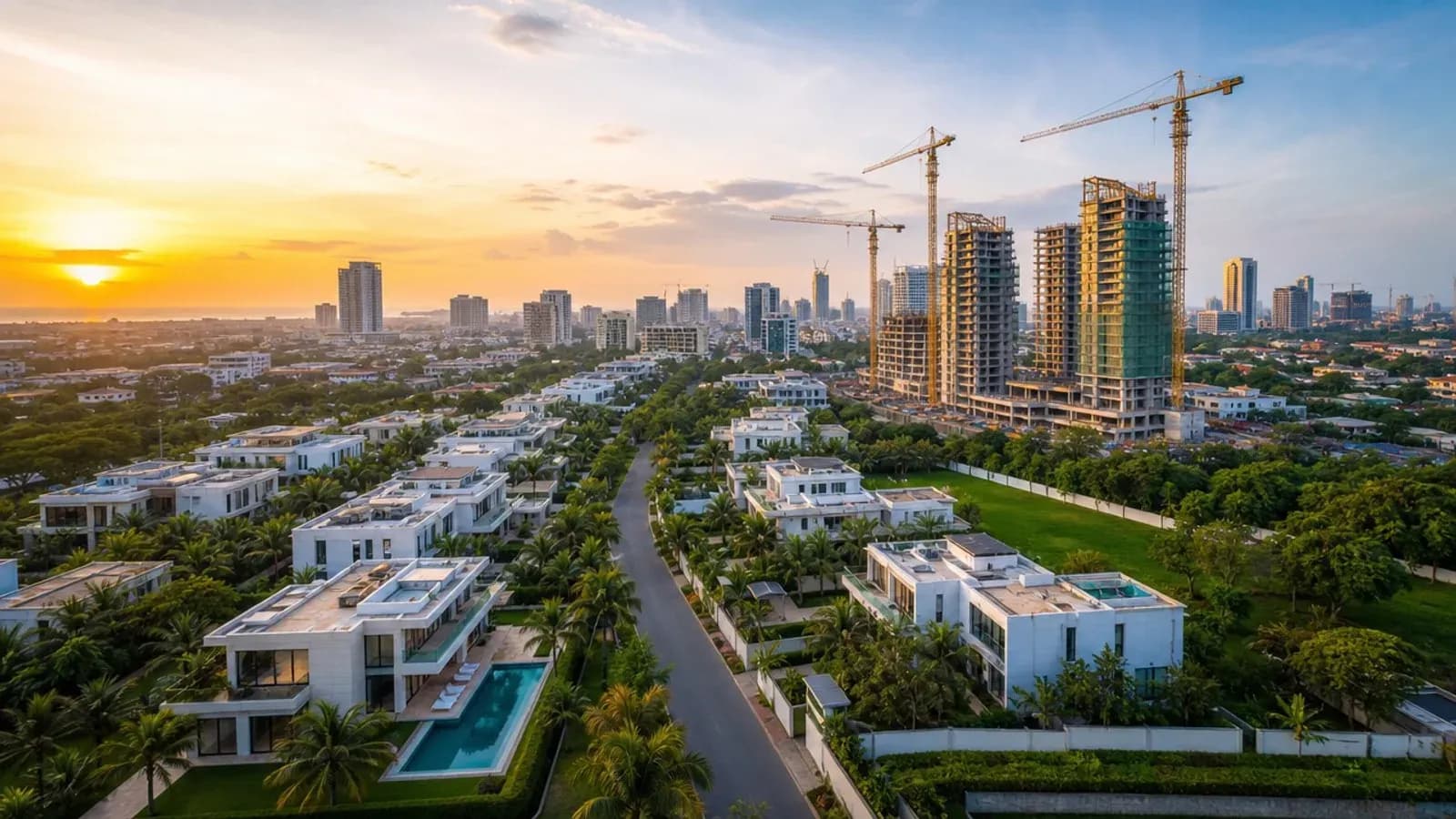
TL;DR — Ghana's housing market in 2026 is a story of structural undersupply meeting broad-based domestic demand. The deficit is commonly put at around 1.8 million homes, local buyers account for roughly 80–85 percent of purchases, and mortgages — though still a small share of the market — are finally usable for foreign earners too. The money is moving along Accra's growth corridors, led by the north-east, while older suburbs open up for redevelopment and regional capitals attract lifestyle buyers. The risks have not changed: unverified titles, milestone-less payments and oversupplied luxury pockets. This report covers demand, supply, prices, finance, where to invest, where to be careful, what lies beyond Accra, and what the next five years look like.
How to read this report
We are a developer, not a bank, so we will tell you plainly where our numbers come from: widely cited industry and public figures, the transaction patterns we see in our own sales room, and a decade of building in Accra. Where a figure is an estimate we say so. Where our interest is obvious — we build estates on a growth corridor — you should weigh that, and we would rather earn your trust by being honest about it than pretend to be neutral.

Demand: who is actually buying in 2026
Three groups are driving the market, and they want different things — but the balance is not what most online commentary suggests.
Local buyers dominate. Roughly 80–85 percent of residential purchases in our experience are made by Ghanaians living and earning in Ghana. Young professional families in tech, finance, energy and the professions have created a growing class of first-time buyers priced out of the established districts and unwilling to inherit a ten-year self-build project. They want finished, titled, mid-market homes on a commutable corridor — the exact segment where supply is thinnest.
The diaspora is significant but secondary. Around 15–20 percent of purchases come from Ghanaians abroad. Remittances into Ghana have been running at record levels — commonly estimated at five billion dollars a year and up — and an increasing share is deliberately targeted at property rather than consumption. The December homecoming season now functions as an informal property fair: viewings booked from London and Toronto in October, keys and family photographs in January. Diaspora buyers overwhelmingly favour gated, managed estates — they need the home to work while they are thousands of kilometres away.
Foreign buyers account for less than one percent of residential transactions. The market is fundamentally Ghanaian.
Investors and landlords round out the picture. Rental yields in well-managed estates remain strong by international standards, and corporate lets around industrial and institutional employment centres stay reliably occupied.
Supply: what is actually being built
The deficit is structural. Around 1.8 million homes short, with urban population still compounding — Accra does not have a demand problem and will not for a generation. What it has is a mismatch problem:
- Ultra-luxury apartments cluster in a few prestige pockets, where supply has at times outrun genuine end-user demand — towers sell floors slowly while families queue for villas
- Mid-market estate homes — the GHS 2.5M–6M finished, titled family house on a growth corridor — remain undersupplied against visible demand
- Informal self-builds still account for most housing starts nationally, which is why the skyline of every road out of Accra is punctuated by grey, half-finished shells: budgets that met cement inflation and lost
The market's centre of gravity is therefore shifting to exactly one product: the professionally built, community-managed, corridor-located estate home. That is not our bias talking; it is where the buyers already are.
The structural bottleneck beneath the headline
The biggest constraint in Ghanaian real estate is not land or even finance — it is the production of affordable construction and finishing materials. Cement, tiles, sanitary ware, fittings and finishing products are either imported at punishing cost or manufactured domestically at limited scale. Until the country builds serious capacity in these industries, housing costs will remain stubbornly high and the deficit will persist. Any investor looking for the opportunity beneath the opportunity should look here: the supply chain that feeds the house, not only the house itself.
Prices and the currency question
Accra property has two prices: the cedi price and the dollar logic underneath it. Construction inputs — cement, steel, fittings — track the exchange rate, so replacement costs ratchet upward with every bout of cedi weakness, and finished-home prices follow with a lag. This is why quality property has historically served Ghanaians as an inflation shelter: the house repriced; the savings account did not.
For buyers this cuts two ways in 2026. Earning in dollars or pounds makes Accra's mid-market look inexpensive against any comparable world city — a finished four-bedroom estate villa for the price of a modest flat share elsewhere. Earning in cedis argues for buying sooner and finished rather than slowly and yourself, because a three-year self-build re-prices its materials many times, always in one direction.
Finance: the mortgage market grows up
Ghana's mortgage market is still small — under two percent of GDP by most estimates, against 20–80% in mature markets — but it is no longer theoretical. A handful of banks run genuinely active mortgage desks: Ecobank, Stanbic Bank, First National Bank, Republic Bank and Absa Bank are the names our buyers meet most often, and all five have financed Green Opal homes.
The practical picture in 2026:
- Cedi products run at high-teens to mid-twenties percent over 10–20 years — workable for cedi earners whose incomes ride the same curve
- Dollar products for foreign-income buyers run roughly 9–13%, with deposits of 20–30% — this is the quiet revolution, because it converts diaspora intent into completed purchases
- Bank verification is free protection: the lender's own valuation and title review add an independent layer of assurance to every financed purchase
Our mortgage guide covers the mechanics in detail, and every listing on this site carries a repayment calculator set to its price.
Where to invest — and where to be careful

Accra grows along corridors, and the returns go to whoever buys the corridor before the infrastructure finishes catching up.
Where the momentum is
In 2026 the strongest case is the north-east: the N4/Adenta–Aviation corridor, where estate supply, road upgrades and the coming Accra Trade & Exposition City are compounding value — four-bedroom estate homes still transact at roughly half their East Legon equivalents. East Legon Hills and Borteyman (West Trassaco) have emerged as two of the corridor's fastest-growing residential areas, drawing young families and first-time buyers with well-planned estate developments at more accessible price points than the established core. The next ring out — Oyarifa and the Ayi Mensah foothills — is where patient land money is already positioned. East Legon remains the store of value: you buy it to keep wealth, not to multiply it. Tema's community corridors offer the deepest rental demand thanks to the industrial employment base.
Redevelopment suburbs to watch
Accra's growth story is not only about greenfield corridors. Tesano, North Kaneshie, Achimota and Dansoman are mature suburbs with established infrastructure, central locations and genuine neighbourhood character — the kind of settled urban fabric that new estates take a generation to build. Many properties here sit on leases approaching expiry, which depresses current values but creates an opening: developers prepared to undertake the title regularisation work can unlock significant value in locations that are already well-served by roads, utilities and commercial amenity. Expect to see more thoughtful redevelopment in these suburbs over the next decade.
Pockets of quality across Greater Accra
Beyond the named corridors and redevelopment suburbs, Greater Accra is a city of sharp contrasts. Within the sprawl there are genuinely quiet, well-serviced residential pockets — streets with maintained access roads, reliable utilities and a residential calm that belies the energy of the wider city. These neighbourhoods do not appear on most corridor maps, and identifying them requires local knowledge and careful site visits, but the value they offer is real. Buyers willing to do the legwork — or work with an agent who knows the terrain — can find liveable, commutable homes at prices well below the estate market.
Beyond Accra — regional living
Several regional capitals offer genuinely attractive options for retirees, remote workers and anyone whose livelihood no longer requires a daily Accra commute. Kumasi, Takoradi, Ho and Koforidua stand out: the cost of living is materially lower, the pace of life is slower, and each has a social infrastructure — schools, hospitals, markets, places of worship — that functions independently of the capital. The trade-off is straightforward: the commercial and professional economy thins significantly outside these centres, and the leisure and lifestyle amenities that expatriates and returnees may expect are still developing. For the buyer who values space, community and a lower overhead over proximity to Accra's economic engine, these towns deserve serious consideration.
The caution list
The caution list is as important as the opportunity list. Unregistered family land remains the single largest source of disputes in the country — no bargain survives a failed Lands Commission search. Parts of the ultra-luxury apartment market are working through oversupply; buying there is a bet on a thin resale market. Flood-prone lowlands are being quietly repriced as climate stress makes drainage a valuation issue. And any offer engineered to be irresistible to people who cannot visit — the classic "diaspora special" — deserves double the verification, not half.
The pitfalls that keep repeating
Every year the same three mistakes destroy the most value, and none of them is subtle:
- Paying before verifying the title. The Lands Commission search costs little and takes days. Skipping it has cost families their entire savings
- Paying without milestones. The working protection is a written schedule that releases money only against photographed, dated progress — never hand over the full sum upfront
- Building alone from abroad. The absentee self-build — funds wired to a relative, progress reported by phone — remains statistically the most expensive way to acquire a house in Ghana
What is working
The honest good news: the market is solving its own trust problem. Buyers now routinely demand registered titles up front, and serious developers publish them. Track records are walkable — completed estates with residents to talk to have become the real sales brochure. Dated construction photography — the build diary — is emerging as the industry's proof-of-work standard; we publish one for every Green Opal residence and believe within a few years no credible developer will sell without one. Dollar mortgages have connected diaspora income to formal finance. Estate management has professionalised: security, water resilience and maintenance are increasingly bought as a service rather than improvised.
The next five years

Our view of 2026–2030, held with appropriate humility:
- The corridors win. Infrastructure spending and the Trade & Exposition City anchor the north-east; values converge toward — not to — established-district levels
- Mortgages deepen. Every year the dollar-product borrower pool widens; by 2030 financed purchases will feel normal, not novel
- Land records digitise. Ongoing Lands Commission modernisation shortens searches and squeezes the room in which title fraud operates
- Climate becomes a spec sheet item. Drainage, water storage and build quality will separate the market — cheap builds on poor ground will age very badly
- The mid-market estate becomes the default. Ghana's first-purchase culture shifts from "buy land, build someday" to "buy finished, live now" — the same transition every urbanising economy eventually makes
- Construction materials localise. The developer or investor who solves affordable cement and finishing-product manufacturing will reshape the entire cost structure of Ghanaian housing
Where Green Opal stands in this
Our thesis is the report in miniature: build finished, titled, mid-market family homes in managed communities on the strongest growth corridor, price them sensibly, and prove everything — title documents shown before you ask, completed streets you can walk, build diaries you can read from any timezone. If the market of the next five years looks the way we have described, that is less a prediction than a description of what we already build. The collection is on this site; the team answers directly on WhatsApp; December viewing slots fill by October.
Frequently asked questions
Is 2026 a good time to buy in Ghana?
For end-users and long-horizon investors, yes — undersupply is structural and corridor infrastructure is being built now. Timing the cycle matters far less than verifying the specific purchase.
Should I hold my budget in cedis or dollars while I decide?
We are not currency advisors. What we observe: construction costs track the dollar, so long deliberation has historically been expensive in cedi terms. Decide on evidence, not on exchange-rate hope.
Is renting first sensible for returnees?
Often, yes — a year's rent in your target area is cheap market research. Rent in the corridor you intend to buy in and use the year to verify your purchase properly.
How do I start from abroad?
Read our twelve-month plan and the from-abroad buying guide on this page, then send one WhatsApp message. Everything after that is a checklist, and most of it can be done from your sofa.
Put this into practice
See the homes behind these guides.
Titled residences, a walkable track record and photographed build progress — in Adenta, East Legon and Cantonments.